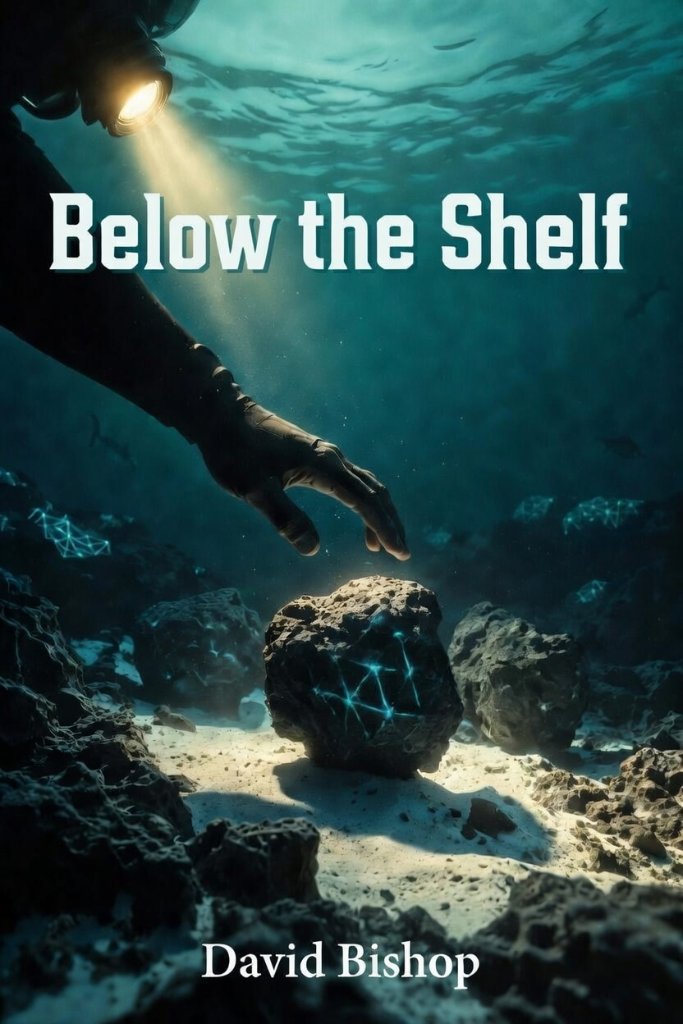
Announcing: Below the Shelf
The Question That Wouldn't Let Go
I didn't start with a plot. I started with a question that genuinely unsettled me:
What if something could make you better—smarter, sharper, stronger—and that was the terrifying part?
Most thrillers give you a monster. A villain. Something to run from. Below the Shelf is different. The thing that comes up from 90 feet off the Florida Gulf Coast doesn't kill you. It improves you. And the book asks whether you'd fight it.
I'm not sure I could answer that question honestly for myself. That discomfort is baked into every chapter.
Where It Came From
I've spent a lot of time thinking about what it means to be human. Not in an abstract philosophical way—in the practical, daily way that comes from watching people make decisions I don't understand, including myself.
We spend enormous energy trying to be better versions of ourselves. Better focus. Better health. Better memory. Less sleep. More output. The self-optimization industry is worth billions precisely because humans are deeply, chronically dissatisfied with their limitations.
So I asked: what if something just fixed it? No discipline required. No habit stacking. No sleep hygiene. Just forty seconds holding something you shouldn't have picked up off the ocean floor, and three weeks later you're sleeping four hours and thinking faster than you ever have in your life.
Would you report it? Would you tell anyone?
Maya Reyes doesn't. Not at first.
The Book I Was Trying to Write
I wanted to write the kind of book I grew up reading at 11 PM under a flashlight. The kind where the science feels real enough that you google it the next morning. Michael Crichton did that to me with The Andromeda Strain and I never fully recovered.
I wanted real geography—Fort Walton Beach, the Gulf shelf, NAS Pensacola. Real science—myelin sheath modification, panspermia theory, self-assembling nanostructures. Real institutional behavior—not a cartoonish government villain, but a Naval Intelligence commander who is genuinely trying to solve a problem and solving it completely wrong because her entire framework for understanding it is insufficient.
That's the thing about bureaucracies. They're not evil. They're categorical. They don't do well with things that don't fit existing categories.
What comes up from the shelf doesn't fit any existing category.
The Part That Cost Me Something
Tommy Reyes is Maya's younger brother. He's 22. He's on her boat.
He's in the 8-to-12 percent for whom the mutation doesn't stabilize.
Writing Tommy's arc through Acts Two and Three was hard in a way I didn't anticipate. Not because it's graphic—it isn't, not in the conventional sense. But because I made a decision early on that Tommy wouldn't become unrecognizable. He would stay himself. His humor. His loyalty to his sister. His stubbornness.
He just keeps becoming something that standard medical tests stop reading as fully human.
That's harder to write than a monster. A monster you can fight. Tommy you can only grieve, and even the grieving is complicated because he's not suffering—at least not in any way he can articulate.
I think about Tommy a lot. More than most characters I've written.
What This Book Is About, Really
On the surface it's a techno-thriller. Propulsive pacing, short chapters, three converging POVs, a clock running in the background nobody set.
Beneath that, it's about what we would give up to stop being limited. It's about the failure modes of institutions that were never designed for problems this novel. It's about loyalty under impossible pressure—every major character faces a test in Act Three that has no clean answer.
And it's about patience. Whatever left those objects on the ocean floor wasn't thinking in human time. Forty thousand years is a rounding error to a civilization capable of seeding a planet and waiting for the results.
That's the horror that stayed with me long after I typed the last page.
Not what the objects do.
The patience behind them.
Available Now
Below the Shelf is available now on Kindle.
If you like Crichton, Grisham, or anything that makes you miss sleep, I think you'll find it worth the lost hours.
David Bishop
Author of Below the Shelf, The Prometheus Sequence, The Iron Shepherd, and The Reclaimed Soul Series