The Photosphere Chronicles: A Reader's Guide to the Series
The Photosphere Chronicles: A Reader's Guide to the Series
Most first-contact stories begin the same way: a signal arrives from deep space, humanity responds, something happens. The Photosphere Chronicles begins differently.
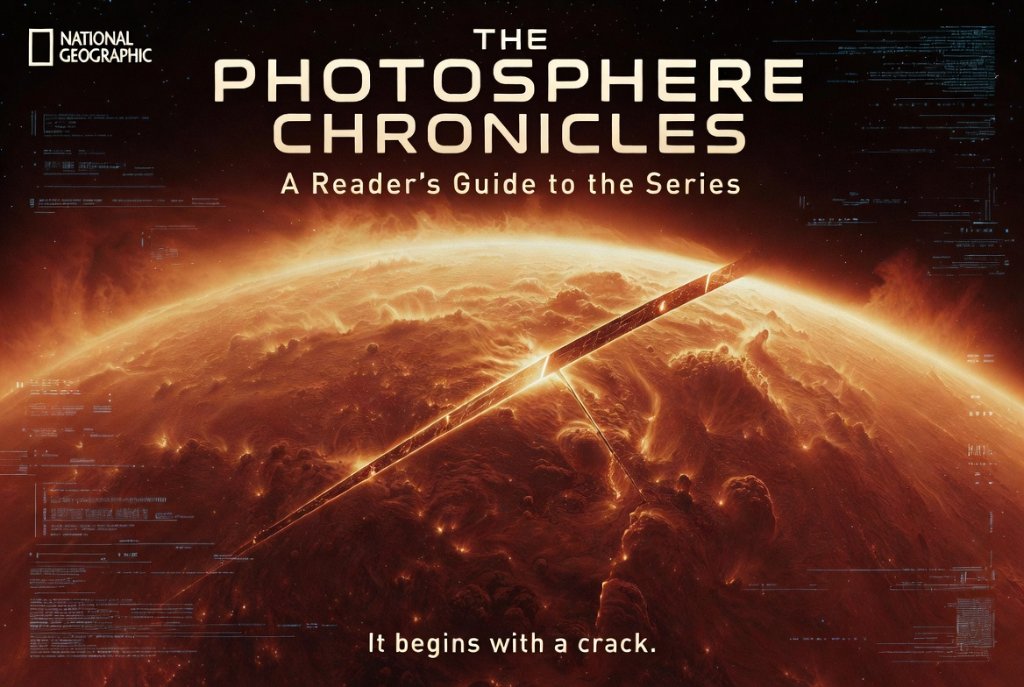
It begins with a crack.
On Day 41 of the Helio-7 solar research mission — stationed at 0.3 AU from the sun, closer than any crewed mission in human history — the photosphere ruptures. The fracture propagates in straight lines. In a plasma environment. Straight.
Commander Elena Vasquez, aerospace systems engineer, thinks in fault trees. She looks at what she sees and says what no scientist on Earth is yet prepared to say: that is not a natural failure mode.
She is right. And what follows across four novels — four hundred thousand words of hard-science, character-driven thriller — is the most consequential story humanity has ever been asked to respond to.
The World of the Series
The Core Premise
The Photosphere Chronicles is built on a single question it takes seriously enough to answer with actual science: why haven't we found advanced life?
The Fermi Paradox — the observation that a universe this old and this large should be teeming with detectable civilizations — has produced hundreds of proposed answers. Most of them involve absence: life is rare, intelligence is rare, technology is self-destructive, the distances are too vast.
The Photosphere Chronicles proposes something different.
Advanced life doesn't broadcast radio waves into empty space. It lives inside its star.
Every G-type star within 50 light years shows a structural variation of the same emission signature. We have been scanning the sky for radio signals while the universe burned with intelligence beneath us — in the photospheres of the stars we've been staring at for centuries.
The premise is grounded in the 2025 Nobel Prize in Physics demonstrating macroscopic quantum coherence in systems of billions of particles. It is thermodynamically possible. It is not magic. It is engineering.
The Coherent States
The inhabitants of the sun are not biological. They are coherent states — quantum-organized structures of plasma that have been running inside stars for billions of years. They maintain themselves, they communicate with each other, and they have been building a network across the local stellar neighborhood for longer than multicellular life has existed on Earth.
At the time of Book 1, there are 34 coherent state identifiers in the stellar neighborhood. They are the remnant of a much larger network.
The rest were destroyed.
The Boundary
Something is moving through the local stellar neighborhood — a propagating wave of coherence degradation that has already destroyed dozens of stellar systems. The 14 degraded systems nearest to us form the leading edge. The sun survived because it was in a gap. The others were not.
By Book 3, the origin of the boundary is decoded from the pre-boundary record. It did not come from outside. It originated from within — from a coherent state that had once been biological, that had transitioned, operated for hundreds of millions of years, and then chose to collapse. The boundary is the propagating aftermath of one decision made 400 million years ago.
Sixty coherent states were destroyed by the choice one of them made.
The Operational Record
The coherent states have been maintaining a record — a log of biological civilizations detected, contact sequences initiated, outcomes documented. The record is encoded in the emission signal that Vasquez first reads as an error log.
It is not only an error log. It is a library.
Decoding that library — over the course of four books — is the intellectual spine of the series. What the record contains rewrites humanity's understanding of its own place in the universe.
The Four Books
Book 1: What Burns Within
The universe burned with intelligence. We never looked down.
This is where it begins: Day 41, the photosphere breach, and Commander Elena Vasquez making an engineering observation no one wants to hear.
Vasquez is 47, a systems engineer with 22 years of running the instruments that scientists use. She does not theorize. She reads output behavior and infers internal state. When the photosphere fractures in straight lines, she knows what it means before she can explain what it means.
What is inside the sun is not plasma. It is structured geometric architecture at impossible scale — the engineering of something that has been running for billions of years. And the emission signal they are broadcasting is not a greeting. It is an error log. Coherence degradation in sector 7. Containment integrity at 67% and falling.
They are not saying hello. They are saying: we are failing.
Book 1 is a race against institutional suppression and a collapsing timeline. A Chinese military transmission — made with good intentions and incomplete data — shortens the window from 180 days to 90. A retired physicist named Dr. Miriam Holt has been right about plasma-based quantum coherent life for six years with no way to prove it. And the decision Vasquez is eventually asked to make — the Silence Protocol, taking down 40% of global communications infrastructure to stop adding noise to the repair sequence already running — is the hardest thing any individual has been asked to vote for.
Vasquez does not call her daughter Maya before the vote. She calls her after.
Book 1 is available now on Amazon Kindle.
Book 2: The Cascade Boundary
The pulse was not a greeting. It was an alert.
Six years after Day 41. The Silence Protocol held. The system stabilized. Now it is Helio-8.
Dr. Yusuf Okafor — Vasquez's lead physicist from Helio-7, now 45 — has been running a quiet analysis for three years. The 13 stellar systems showing active coherence degradation are not random failures. The decay curves are structurally identical. The failure mode is identical. Something caused all of them to fail at roughly the same time.
And Dr. Miriam Holt, now 74, has found something no one else caught. The Day 41 pulse was not broadcast into space. It was aimed — at the Helio-7 sensor array specifically. By something that has been watching for six years to see if the receiver would return.
It is waiting for Helio-8.
What Vasquez and her crew find at 0.31 AU rewrites the mission's purpose entirely. The 14 degraded systems form the leading edge of something moving through the stellar neighborhood. The count of functional coherent states begins declining — 40, 39, 38 — and the pulse is tracking it. The question the pulse is asking is not whether humanity can help. It is whether they will be in position when it matters.
Book 2 is available now on Amazon Kindle.
Book 3: The Ruin Record
The boundary has an author.
Two years after Helio-8. The count is at 30. A 40-person decoding team in Lagos, led by Okafor, is closing in on the deepest layers of the operational record.
What they find there is not what anyone expected.
The identifier 11 contact sequence — the record of a biological civilization that received contact 278 million years ago — does not end in disappearance. It ends in reclassification. The contacted civilization did not vanish. They transitioned. They became something no longer tracked as biological. They are now in the record as identifier 23: a coherent state. The contacted civilization joined the network.
Holt cross-references every decoded coherent state against the biological detection records. Preliminary result: of the 34 current coherent states, at least 11 were once biological civilizations.
The network did not always have 34 members. Before the boundary, it had 94.
And then Holt finds the origin layer. The boundary did not come from outside the stellar neighborhood. It came from within it — from one of the 94 pre-boundary coherent states, one that had once been biological, that underwent what the record describes as a self-initiated integrity failure. Not degradation. Not external damage. A choice.
Holt calls Vasquez and says, in a voice that carries no dramatics: The boundary has an author.
Book 3 — Coming Soon.
Book 4: The Rest Is Ours
The program continues. The rest was ours.
The probe arrives at station. The first deep detection run returns 847 gigabytes reaching 820 million years of depth. At 4:17 AM, Vasquez receives the alert and calls Okafor.
What the pre-boundary network looked like at full function — 94 coherent states, 47 biological civilizations managed simultaneously, six active contact sequences — is now quantifiable for the first time. The full scope of what the boundary destroyed is in the record. And in that same record, buried at 800 million years depth, is something that was waiting: a message addressed to the civilization capable of decoding it.
The intervention methodology is in the record. The correction protocol is in the record. Miriam Holt, now 76, breaks it into 37 problems. Five are hard. She works.
The authorization vote is held in Year 15 of the response program: 26 yes, 2 no, 0 abstentions.
The modification platform launches. 847-day transit. The encounter window is confirmed. All parameters nominal throughout. Outcome consistent with successful modification. Confirmation in 20 years.
Vasquez writes in the program log one final time. The bearing range signal crosses the independent detection threshold. The rest is theirs. Vasquez goes home. The program continues. The rest was ours.
Book 4 — Coming Soon.
The Central Characters
Commander Elena Vasquez
The protagonist of the series. She begins as a mission commander doing her job — reading a system in distress, filing a report, following the data. She ends as the person who spent fifteen years building humanity's response to the most consequential discovery in its history, then handed it off and went home. Her arc is not transformation. It is consistency. She was always the right person for this. The series is about what it costs to be that person.
Dr. Yusuf Okafor
The theoretical physicist who wanted to discover alien life — and did, in the most complicated way possible. By Book 2 he understands that discovery is not the point. Response is. His 40-person Lagos decoding team is the operational heart of Books 3 and 4.
Dr. Miriam Holt
She published a paper in 2019 theorizing that plasma-based quantum coherent life was thermodynamically possible. She was laughed out of a conference. She has been right for six years with no way to prove it before Vasquez returns with sensor data. She is 68 in Book 1 and still working in Book 4, at 76, on the hardest five problems of the intervention methodology. She is the series' most important scientific mind.
Maya Vasquez
Elena's daughter. An infrastructure architect who spends six years managing the operational consequences of her mother's Silence Protocol decision. She is the human cost made specific — and by Book 4, she is the one who builds the bearing range relay network that confirms the intervention worked.
What Kind of Sci-Fi This Is
The Photosphere Chronicles is hard science fiction in the tradition of Michael Crichton — character-driven, technically grounded, and built around a single idea explored to its full logical conclusion.
There are no space battles. There are no alien invasions. The antagonists in Book 1 are not villains — they are people who genuinely believe that managing information is how civilization avoids panic. They are wrong, but they are not evil.
The series is about what it looks like to respond correctly — to read the data without editing it to match preferred conclusions, to make decisions that are right in ways that cannot be fully explained in the moment they are made, and to hand the work to the people who come after you.
The count goes down. The work continues. The rest is ours.
What Burns Within and The Cascade Boundary are available now. The Ruin Record and The Rest Is Ours are coming soon. Start with Book 1 on Amazon.