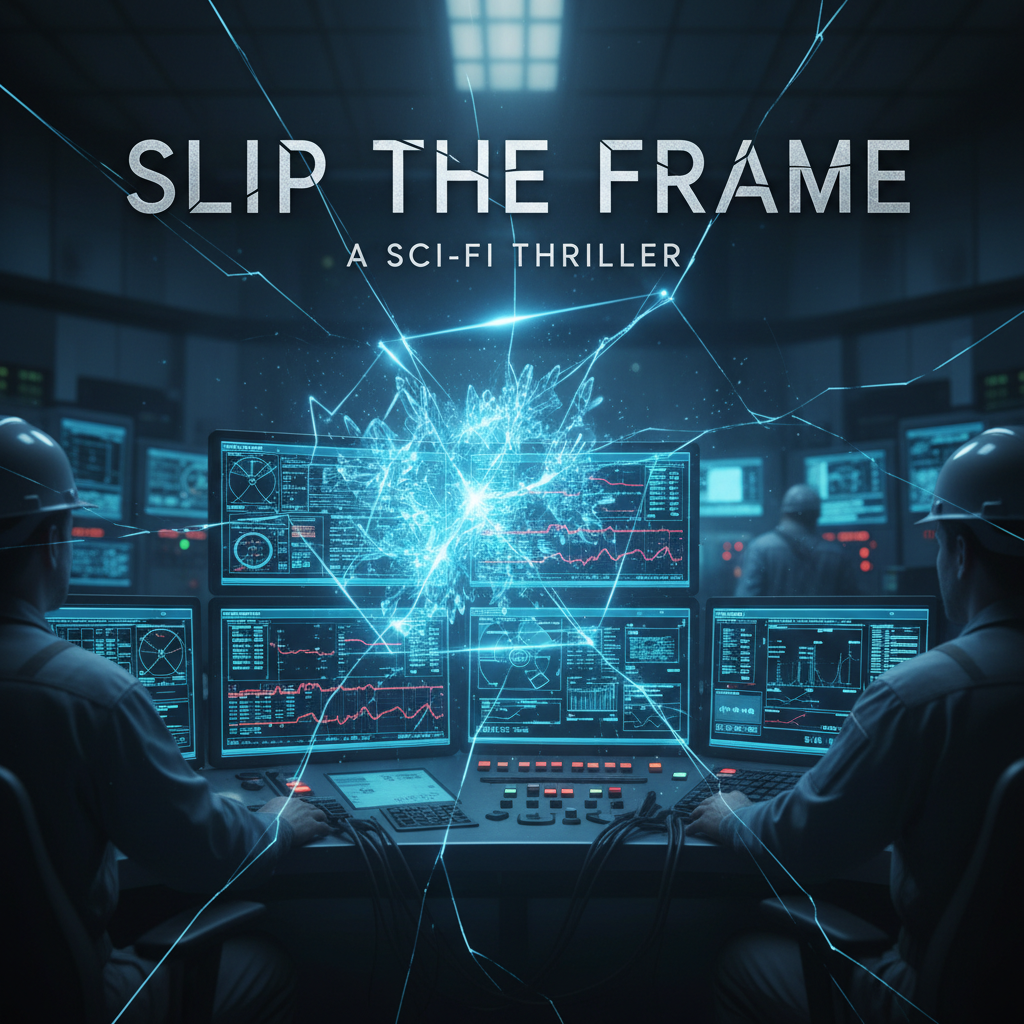
Slip the Frame: The Engineer Who Found the Seam in the World
The World Has Layers the Eye Cannot See
There is a moment in every engineer's career when the data says something the manual doesn't cover.
For Caleb Rourke — 44, senior controls engineer, president of his own automation firm — that moment comes on a Tuesday in October at a nuclear power plant in Findlay, Ohio. A routine HMI retrofit. Standard commissioning. And then a PID loop runs smoother than it should.
Then the world skips. Half a second.
He logs two data points in his phone. That evening, in a hotel room, he begins the fault record.
Slip the Frame is the story of what happens when an engineer treats the impossible the way he treats every other system failure: observe, document, follow the data. Do not edit for comfort.
The Veil
What Caleb discovers is not a parallel dimension. It is not magic. It is not a superpower.
It is infrastructure.
The Veil is a hidden layer of reality — a care system built to attend to the physical world, monitor its condition, and relay that condition to a receiver outside the known universe. It has been running for longer than anyone can measure.
And for the last 174 years, it has been running in a degraded fault state.
The People Who Kept It Ready
Caleb is not the first person to find the seam. He is the person who closes the circuit.
Agnes Whitmore named it right. Gerald Simms carried the knowledge forward. Dorothea Vance — 89 years old, retired naval electronics researcher — has been monitoring the Veil's four anchor points for 63 years, keeping everything ready for the person who could finish the job.
And then there is Edmund Hale. A land surveyor, born in 1801, who entered the Veil during a thunderstorm in 1847 and never fully returned. He has been waiting — partially dissolved into the architecture of the system — for someone to complete the correction sequence.
Every walker builds on what came before.
Engineering the Inexplicable
What makes this book different from most sci-fi is the methodology. Caleb does not panic. He does not theorize wildly. He does what he has done for 22 years of industrial automation work:
- Log what you observe
- Do not speculate beyond the data
- Follow the fault tree
- Execute the correction
The four-anchor-point correction sequence that forms the spine of the book reads like a field commissioning report — if the field were the hidden architecture of reality itself.
The Most Important Revelation
I will not spoil the ending. But I will tell you the thematic core.
The Veil is not a threat. It is not a mystery to be solved and filed away. It is not a weapon or a resource.
It is a care system.
Built to attend. Built to watch. Built to relay.
The most important revelation in Slip the Frame is this: none of them were alone.
The word that echoes through the final chapters — encoded in a signal from 1978, addressed to the circuit-closer — is the simplest instruction in the book:
Continue.
Book 1 of The Veil Chronicles
Slip the Frame is the first installment of The Veil Chronicles. 27 chapters. 76,766 words. Four parts: Fracture, The Architecture, Correction Sequence, and Nominal Operation.
It is available now.