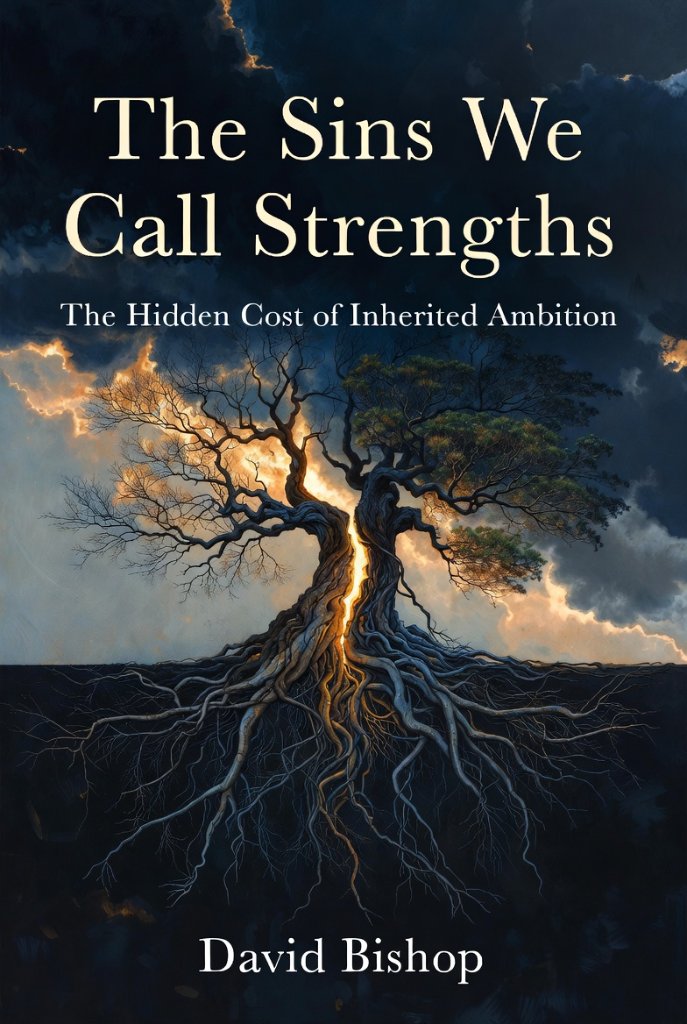
The Sins We Call Strengths
The Hidden Cost of Inherited Ambition
by David Bishop
How seven traits traditionally celebrated as virtues become destructive when taken to extremes and transmitted across generations.
The Story
The Sins We Call Strengths examines how grit, perfectionism, self-reliance, discipline, ambition, confidence, and provision—traits traditionally celebrated as virtues—become destructive when taken to extremes and transmitted across generations. Drawing on developmental psychology, family systems theory, neuroscience, epigenetics, and biblical wisdom, this book traces how families create unwritten formulas for success that persist long after the original context has disappeared. Every strength, pushed far enough, becomes something else entirely. These patterns don't appear from nowhere—they are inherited, passed silently from generation to generation, intensifying with each transmission. For the accomplished who are suffering: those who have succeeded by the standards they were given and still feel empty, driven, unable to rest, never quite satisfied.
Book Structure
The Anatomy of Inherited Ambition
How families create success formulas, why those formulas decay over time, and how traits mutate across generations. Chapters 1-4.
The Seven Sins We Call Strengths
An examination of grit, perfectionism, self-reliance, discipline, ambition, confidence, and provision—and how each becomes destructive. Chapters 5-11.
The Breaking Point
When accumulated patterns finally collapse and the grief and conversation required to move forward. Chapters 12-14.
The Path Forward
Rewriting inherited scripts and becoming a source of healing rather than harm. Chapters 15-16.
Key Features
The Seven Sins
Deep examination of how grit, perfectionism, self-reliance, discipline, ambition, confidence, and provision cross the line from strength to suffering.
Family Systems Approach
Integrates developmental psychology, family systems theory, neuroscience, epigenetics, and biblical wisdom.
Practical Pathways
From diagnosis to transformation—choosing what to keep, what to release, and what to add from your inheritance.
Generational Impact
Become a different kind of ancestor—one whose legacy is freedom rather than compulsion.
Major Themes
Generational Compounding
Inherited traits don't just persist—they intensify like interest on a debt no one remembers incurring, compounding across generations.
The Mutation Effect
Traits mutate through amplification, reaction, and displacement—all unconscious unless examined.
The Body Keeps the Score
Inherited patterns are not merely psychological—they are physiological, manifesting in cardiovascular disease, autoimmune conditions, and chronic stress.
Naming as Healing
You cannot change what you cannot see, and you cannot see what you have never named. Speaking patterns aloud is the first step toward transformation.
Book Details
Author
David Bishop
Category
Self-Help
Chapters
16